Size range
When there are particles present which are outside the measurement range of 10-300nm, the measurements will become
distorted. Here's how:
- Very small particles (below 7nm) cannot be charged in the Partector 2, and therefore are not detected at all. Particles from 7 to 10nm are all detected as 10nm particles, but the smaller they are, the more their number concentration will be underestimated. Therefore, if you have a relevant number of particles below 10nm, the measured particle number concentration will be too low. Note that such "cutoff" effects also happen for other aerosol instruments.
- Large particles (above 300nm) will acquire a high charge, and will produce measurable signals in the electrometers.
Under normal circumstances, there are two or three orders of magnitude fewer particles larger than 300nm than below; so
even though these individual large particles carry a high charge, they hardly affect the measurement. However, in special conditions
there may be more larger particles, e.g. in dusty environments, during Sahara dust events, for hazy conditions due to forest fires etc.
Generally, such conditions are visible by eye, as the large particles produce visible light scattering to the observer.
If this is the case, then the larger particles will affect the measurements: for the Partector 2 standard, they will appear as
300nm particles, but in a larger number as they carry more charge than 300nm particles would. For the Partector 2 pro, they will
also appear as 300nm particles in a higher number, but in addition, they will "cannibalize" the measurements in the lower size channels.
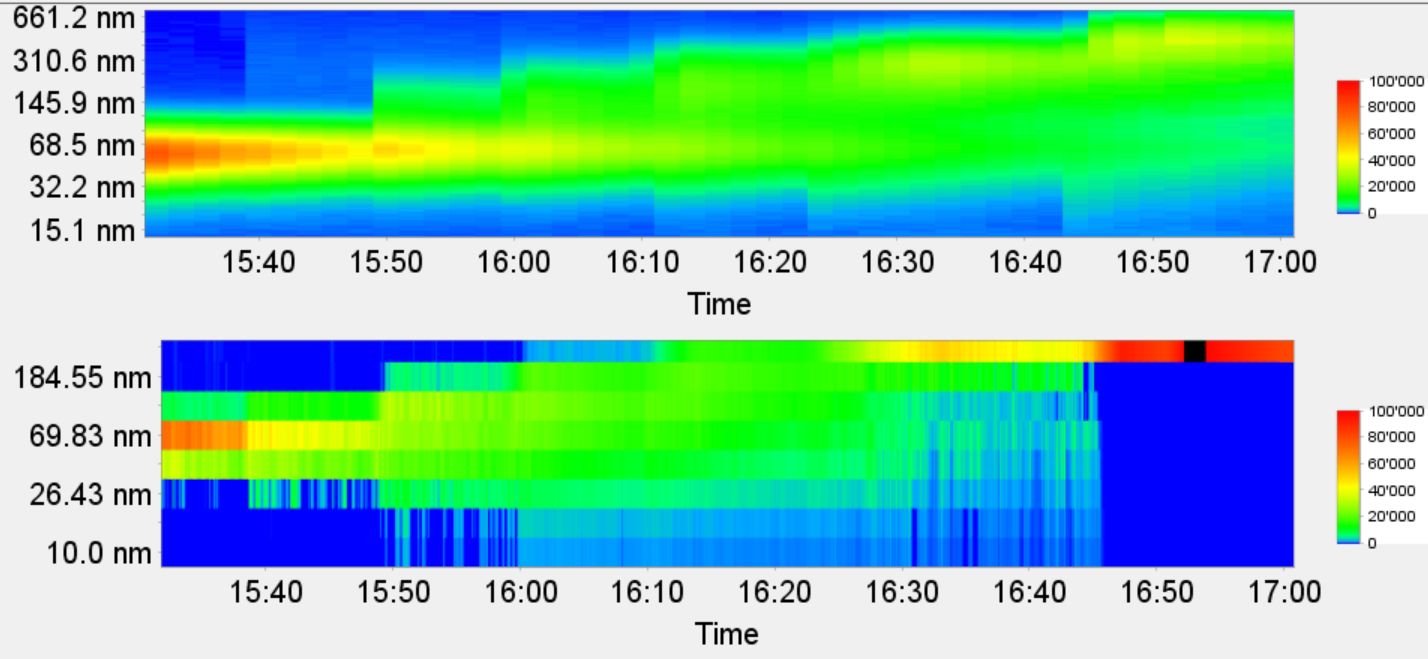
The figure below shows an experiment where increasingly large particles were generated in an evaporation-condensation process in our lab.
The top panel shows the size distribution measured by the SMPS, the bottom panel shows the size distribution measured by the Partector 2 pro.
As more particles grow above 300nm in diameter, the data inversion stops working properly, needing to remove the smaller particles
to achieve a better fit to the observed currents. As a result of the large particles, the Partector 2 pro reports only 300nm particles
in its size distribution with no smaller particles, although the SMPS shows that these particles are present. If you know what to look
out for, you can easily spot such events, and interpret them correctly.